
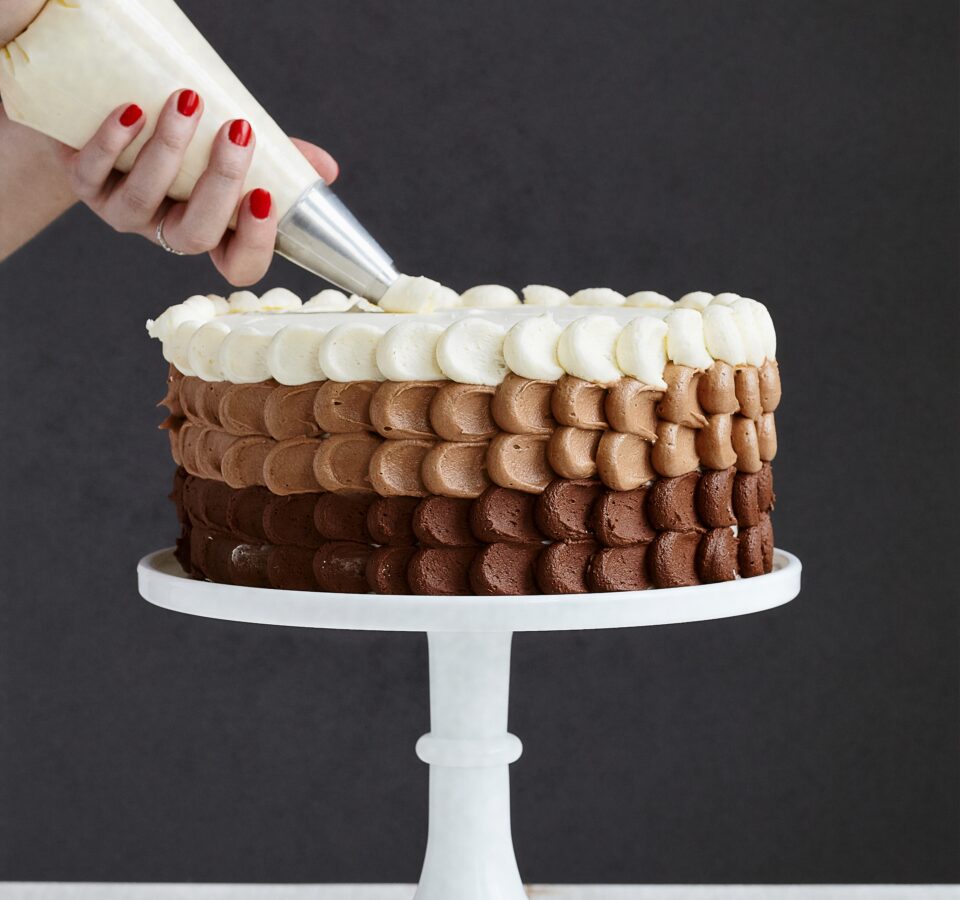
Start piping decorations with three movements: stay still for a star, trace a spiral for a rosette, and reduce pressure while drawing the tip along for a shell. The shape depends on the nozzle, the consistency of the mixture and when you stop squeezing.
This guide focuses on decorative patterns. For choosing, assembling and filling the bag, see how to use a piping bag. Begin with decorating buttercream made from a reliable recipe: not every filling holds raised detail equally well.
Prepare before decorating
- A piping bag with a compatible round or star nozzle and, if used, a coupler.
- A smooth mixture without pieces that could block the opening.
- A flat plate or a surface lined with baking paper for practice.
- A spatula and a cake or cupcakes ready to decorate.
Compare shapes and sizes in the piping bags and nozzles category. Tip numbers and fitting systems vary between brands; do not assume every tip is universal.
Practise a row of identical shapes before working on the cake. Change one factor at a time: pressure, speed or distance from the surface. This makes it easier to identify what improves the shape.
1. Pipe simple stars and dollops
A round nozzle produces a smooth dollop; a star nozzle produces ridges. For a simple star, hold the nozzle vertically near the surface without pressing it against the support.
- Squeeze while keeping your hand in the same position.
- Let the base expand to the desired size.
- Stop squeezing before lifting the tip.
- Move away and repeat, keeping the base size consistent.
Continuing to squeeze as you lift makes a longer tail. The sequence “stop pressure, then lift” is also central to Wilton’s star technique.
2. Pipe a rosette
A rosette is a spiral, rather than a rose built petal by petal. A star nozzle makes visible ridges; different openings produce different patterns. Wilton’s rosette guide shows examples with several tips.
- Choose the centre and position the nozzle close to the surface.
- Make a small centre, then guide the mixture outwards in a circle.
- Keep pressure steady without piling all the buttercream in one spot.
- At the desired size, release pressure and finish at the rosette’s edge.
Practise matching sizes for a cake border. If you want alternating large and small rosettes, decide the sequence first so that spacing stays regular.
3. Pipe a shell border
A shell has a broad beginning and a narrow tail. Use a star nozzle and hold the bag at an angle to the surface.
- Squeeze to form the broad part.
- Gradually reduce pressure while guiding the tip along the border.
- Stop squeezing and finish with a thin tail.
- Begin the next shell so that it slightly covers the previous tail.
This sequence forms the continuous border described in Wilton’s buttercream shell instructions. Keep the same working direction throughout the practice row.
Why is the pattern not working?
| Result | What to check |
|---|---|
| Ridges flatten | Check that the mixture suits the decoration and the recipe’s working temperature. |
| Uneven sizes | Compare squeezing time and distance from the surface. |
| Long tails | Release pressure before moving the tip away. |
| Interrupted flow | Check filling, air pockets and pieces in the bag. |
A neat design does not need to fill every space. Try a ring of stars, a small cluster of rosettes or one shell border, leaving the centre clear. For fruit, edible images and other materials, see our cake decorating ideas.
Piping decoration FAQs
Which decoration should a beginner try first?
A row of dollops or stars lets you practise pressure before coordinating a spiral or a continuous border.
Can I pipe these decorations with whipped cream?
Some patterns work with whipped cream suitable for decorating, but stability and definition differ from buttercream. Follow the preparation and storage instructions of your recipe.
Which nozzle do I need for rosettes?
A star nozzle suited to the desired size. Opening shape and mixture consistency determine the result; a tip number alone is not enough across different brands.
Why do my piped stars have very long points?
You may still be squeezing as you lift your hand. Practise releasing pressure first and check whether the tail becomes shorter.
Does a decorating syringe always replace a piping bag?
No. Grip, capacity, tips and movement precision depend on the tool. Check the syringe’s instructions and practise the pattern before using it on the dessert.

