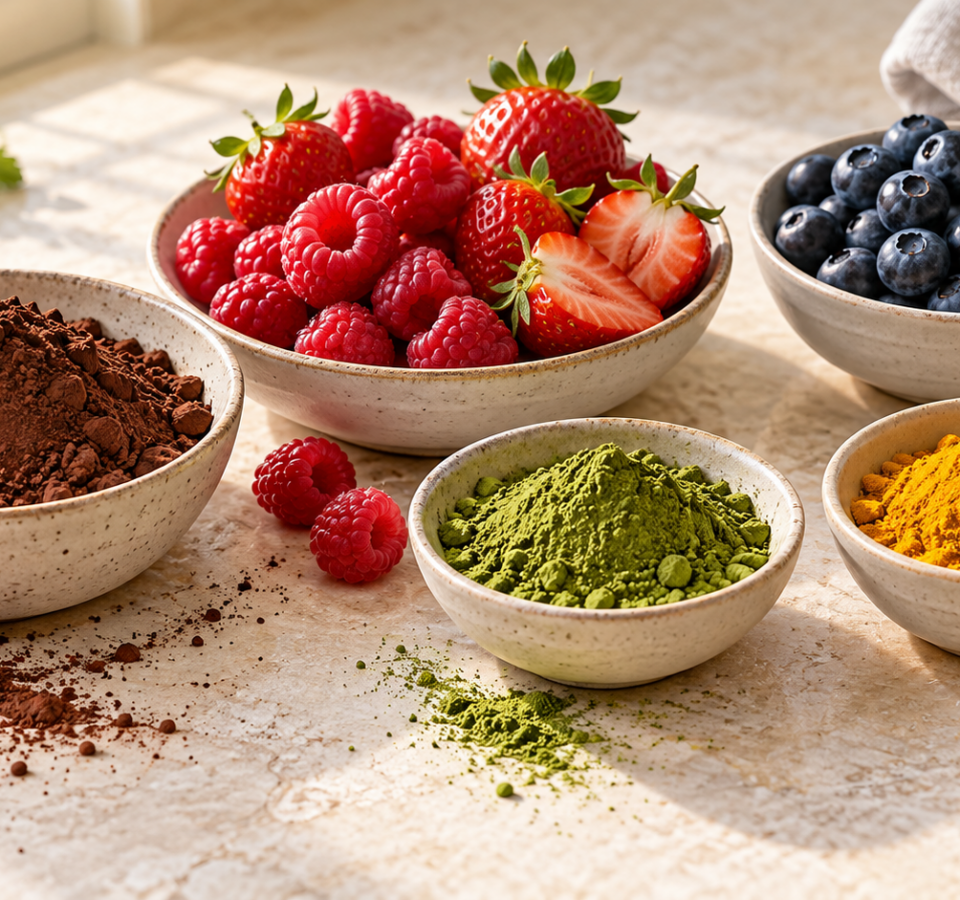
Instead of purchased food colouring, you can use ingredients that also bring colour: cocoa for brown, berries for pink and purple, matcha for green and turmeric for yellow. The result depends on the dessert’s base and the amount used. These ingredients also change flavour, moisture or texture; they are not universal substitutes for concentrated colouring.
Decide whether you want a delicate shade in a cream, a mixture that will be baked, or a precise decoration. An option that works in icing may be unsuitable for chocolate or a biscuit that needs a sharply defined shape.
Natural colouring and colourful ingredients are different
Cocoa contributes flavour and other properties to a recipe as well as colour. A food colouring, even one derived from a natural raw material, has stated uses and conditions. “Natural” alone does not describe concentration, allergens, compatibility or baking performance.
Read the composition and instructions of ready-made products. For pantry ingredients, choose a colour that suits the dessert’s flavour. Our food colouring guide explains formats and uses.
Ingredients to consider for different colours
| Desired shade | Ingredient | Limit to check |
|---|---|---|
| Brown | Unsweetened cocoa. | Adds cocoa flavour and may affect texture. |
| Pink or a gentle red | Strawberries or raspberries, including freeze-dried powder. | The base and fruit affect the shade; purées add water. |
| Purple | Blueberries or other dark berries. | The shade is not identical in every recipe or after baking. |
| Green | Food-grade matcha. | Brings a distinctive tea flavour. |
| Yellow | Food-grade turmeric. | Its flavour becomes noticeable if you add too much in pursuit of a stronger colour. |
Fruit, matcha and turmeric are also discussed in King Arthur Baking’s ingredient-colour guide. Its freeze-dried fruit powder guide explains an option that adds fruit flavour and colour without introducing the same amount of water as fresh fruit.
Test without changing the whole mixture
- Take a small portion of the actual base. Use the cream or icing intended for the dessert.
- Add the ingredient gradually. Mix thoroughly before assessing the effect.
- Check colour, flavour and texture. A pleasing shade does not compensate for a runny cream or an unbalanced flavour.
- Test the final technique. Pipe a sample if it must hold a pattern; bake a small portion if baking is planned.
- Record the amount in the test portion. Scale cautiously and reassess before adding more.
There is no single dose for every cream, fruit or powder brand. For an event, test in advance and keep some of the base without additions.
Creams, batters and chocolate behave differently
A pale base shows subtle shades more clearly; an already yellow or dark base changes their appearance. A purée affects liquid content, while powder becomes part of the recipe’s ingredient balance.
Baking adds another variable. Do not expect a baked cake to keep exactly the shade seen in the bowl. King Arthur’s homemade preparations for icing and toppings are not universal baking colours. A commercial colouring of natural origin may have specific baking directions: check that product.
Juices and purées are not additions to pour freely into pure melted chocolate. Its colouring must suit that particular technique. Compatibility with a watery or fatty preparation comes before the desired shade.
When a ready-made colouring may suit the job
Consider a product formulated for the intended use when you need a repeatable shade, a small dose or a specific technique. In the shop’s food colouring category, compare each product’s intended uses, ingredients and format. Gels, powders and sprays do not all work in the same way.
If a gentle shade and a recognisable flavour are the aim, a colourful ingredient can form part of the recipe itself: a berry cream, cocoa topping or matcha icing has more to offer than appearance alone.
Food colouring alternative FAQs
Can I colour desserts without buying food colouring?
Yes, with colourful ingredients compatible with the recipe. They also change flavour or texture, and the colour may fade during baking.
What are natural food colourings?
Some colourings are derived from natural raw materials, but they are not all equivalent to fruit or spices. Check a ready-made product’s composition and use; consider the whole ingredient’s role in a homemade preparation.
How can I make pink without food colouring?
A pale base can be coloured with strawberries or raspberries, including freeze-dried powder. Test first: moisture, acidity and fruit intensity affect the result.
Can I replace food colouring gel with juice?
Not automatically. Juice adds water and has a different concentration, so it can change icing, cream or batter. Pure chocolate needs particular attention to compatibility.
Is a natural ingredient always free from allergens?
No. “Natural” is not an allergen-free claim. Check ingredients and package warnings when choosing fruit powders or other naturally derived products.