What are food dyes?
A food coloring is simply a chemical compound that can be organic or inorganic, which you can use to change the color of a food product and then will be classified as a food additive.
Food additives are generally added substances to food products to perform certain functions, such as coloring, improving or preserving the appearance and taste and sweetening.
The European legislation defines them as “…any substance not consumed as food as such and that it is not a typical ingredient of food, regardless of whether it has a nutritional value, that it is added to food for a technological end during the phases of production.
Some dyes are of natural origin, others are natural but concentrated or chemically modified, or still synthetic imitations of natural substances, many others are totally artificial and are indicated with the abbreviations E100-E199.
The color of food and objects in general depends on the absorption of the different wavelengths of light, each object absorbs all colors except one that will determine the color.
The function of food dyes
Each of us associates the colors with the flavors, and therefore the color of the food easily influence the perceived taste, as well as smells.
Colourants usually have the task of reproducing the natural color associated with the taste, such as red color in the foods to the taste of strawberry.
In the industrial field, the colouring agent that reproduces the natural colour of the foods has the task of strengthening in the consumer the idea that food is prepared with natural ingredients, and that therefore its taste depends on them (as its taste normally is often due to the use of natural aromas).
Food colourings and European Union rules
In the European Union, food additives must be authorised and used under the conditions set out in the Union list. To check a colouring and its conditions of use, consult the European Commission database.
The E number identifies the additive and may appear on the label instead of its name. It does not replace checking whether the intended use in a food is permitted. In EFSA’s list, E141 means copper complexes of chlorophylls and chlorophyllins; E142 means Green S, not a blue colouring.
EFSA: food colouring identities and assessments.
Food Colorants and Cake Design
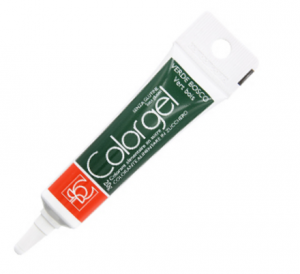
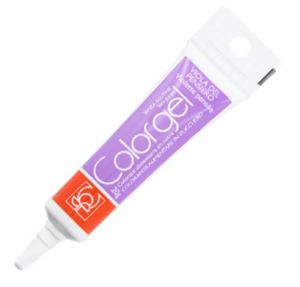
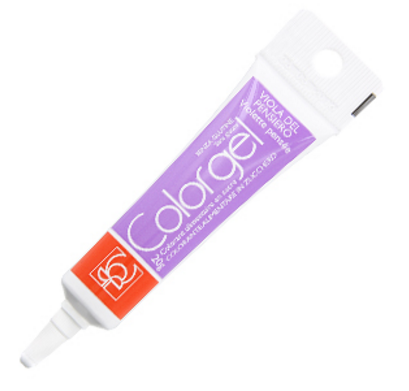
They are used in cake design for ever to give a creative touch, paint characters, objects, flowers, print by food printers and what else we think is appropriate our imagination.
Food dyes exist of three types: liquids, powder and gels, spray.
In Cake Design you can color everything: dough, filling, sugar paste, butter cream, real ice, Gum Paste, and decorations etc…
Let us see how it is possible to color the various elements of our dessert:
Expected: You can use all three types of dyes (powder, gel or liquid) considering that those powdered to slightly dry the dough.
Butter cream: Here too you can use to color the cream one of three types, paying attention to those liquids because they dissolve the cream and make them lose consistency.
sugar paste: gel dyes are recommended because they alter less the consistency of the dough, but it is possible to use also those liquids, paying attention, just a few drops.
Gum Paste: only gel.
The decorations in sugar paste: Once dry, colourings can be coloured with powdered colours dissolved in alcohol and passed by brush or liquid dyes.
Royal ice cream: In this case it is possible to be helped by the 3 types of pigments to adjust the consistency of the ice. If we have a very hard iced, then add the liquid dye. If it is too soft or liquid with the powder coloring agent I can add it a bit. If we have the right consistency the best solution will be the use of the gel that does not alter the consistency.
The techniques for painting with food dyes sugar paste.
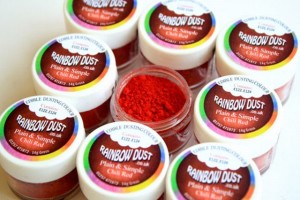
- To get a clean and precise brush, you just need to use a food dye powder and vodka or food alcohol.
To have a less sharp effect more shaded very similar to a watercolor, we will add water to vodka or food alcohol and in the case of use of powdered dye; or you can use the first method obtaining a precise trait but then re-pass it with a brush wet in water, so as to soften and dilute the tract.
Food colorants: where do they buy?
You can buy food dyes on our online shop, you will find a wide range of colors.
Food and Aerograph Colorers
What is theaerograph for sweets ?
It is a tool that is held as a Pencil, consisting of a tank where the colouring and air flow must be inserted, through the compressed air generated, it sprays the food coloring, allowing us to create more or less precise nuances, depending on the adjustment of the nozzle where allowed by the instrument, characteristics of the aerography technique.
Which air conditioner to choose for cake design?
There are two types of aerographs: ACTION SINGOLA or DOPPIA ACTION.
- Single-acting aerograph:
They are more manageable, but they have the limitation to allow only the activation of the air, so when you press the button and we cannot change the coloring flow the jet will remain uniform until the moment when you stop and change the amount to vary the effect.
Single-act aerographs are mainly used for homogeneous sprays, filling of wallpapers, sprays with constant intensity, typical of modeling, ceramics, cold porcelain etc.
- The most indicated are those at DOPPIA ACTION that offer the possibility of having the adjustment of the air flow by pushing the button down and adjusting the color flow by bringing back the lever.
Thanks to this type of aerograph it is possible to color subjects both in sugar paste , in chocolate, cream and every other element of our dessert.
With this type of aerograph, it is possible to perform shades, writings and strokes of 0.2/0.3 mm thickness, so we will have a very high precision.
There are various types of trade double-action aerographs, with different calibration, it is advisable to choose those with a mid-valve of 0.3 mm.
To ensure a long life of the instrument, careful cleaning is necessary at the end of each use, especially if you use food lacquers it is better to clean everything with alcohol and not with the simple lacquer, penalty for hardening the dye or lacquer inside the device and the consequent filling of the nozzles.
What colorants do you use for our aerograph?
There are two types of suitable dyes:
- Colorants Hydrosoluble:
They have the characteristic of creating veils, since they contain less color, we will get soft, stronger and dense colors if you overlap various layers.
- Colorants Hydrocoholic:
They are typically indicated for cover containing alcohol and less water and much color have a more covering action and you can use it on chocolate.
How do you use it and where?
The operation of the aeropenna is simple, just fill the tank with the coloring, connect the pen plane to the compressor and activate it, press the button to start the dispensing. The greater button will be the air out. Pulling the lever towards you, you can manage the intensity of the color.
It is possible to use the free hand aerograph but requires a lot of manual skills, so it will be necessary to do a lot of practice, or a faster and more effective use is the use of handicraft stencils or purchaseable on our site (for example the beautiful edges and moderate laces), to make of stencils from us will use of the sheets of vinegar, scissors and bisturi impact, we will only need to draw and then
The professionals of the sector and cake designers use it to create backgrounds, shades on cakes, illustrations and every decoration for cakes and cakes, can also be used for almond paste, marzapane, cocoa butter, etc.
A frequent use of aerograph and that for the decoration of marzipan fruits or fruit martorana, typical Sicilian dessert.
What is the most suitable coloring for dark chocolate?
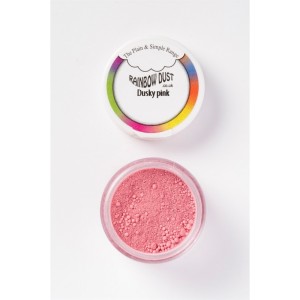
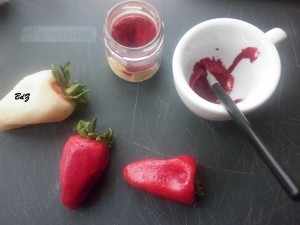
The most suitable are colorings spray base alcohol Using a perlescent powder you can create bright colors, for example with 1g powder and 2g of alcohol and applying by means of a brush.
How to get new colors from primary colors?
The primary colors: Blue, red and yellow.
From these colours you can get the secondary colors from which you can get the tertiary colors.
We create secondary colors: how to make colors.
Yellow + Red = Orange
Red + Blue = Purple
Blue + Yellow = Green
The colors Terziari:
Yellow + Orange = Yellow / Orange.
Red + Orange= Red / Orange.
Red + Purple = Red / Purple.
Blue + Purple = Blue / Purple.
Blue + Green = Blue / Green.
Yellow + Green = Yellow / Green.
Red + Blue + Yellow = Brown
Once you have the base of 12 colours, you can add more red or orange to get a date shade of red, or add more purple or blue to enhance the shade of blue. Following this principle and the color wheel you can create a lot of color varieties. ( How to make brown? read the table )
Pay close attention in the use of food dyes, they can easily stain hands, worktops and clothing.