 History
 History
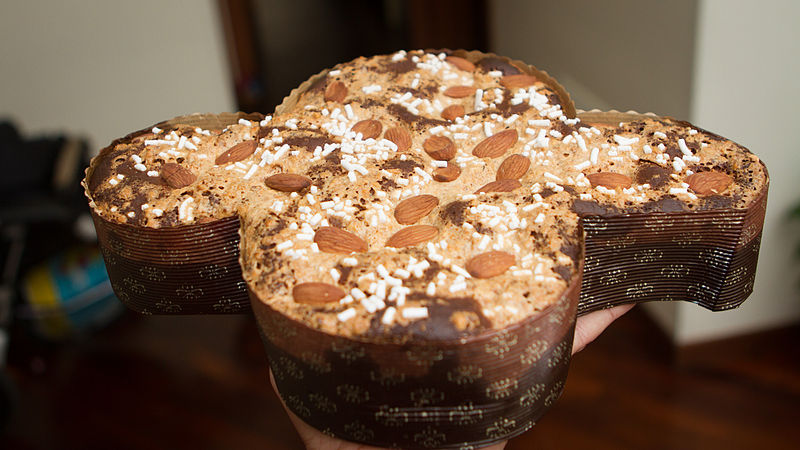
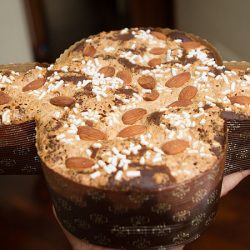
The recipe of the Easter dove was born in Lombardy around 1930 on the idea of Motta, spread quickly throughout Italy, so much to become the typical Easter dessert.
The ancient tradition of the Easter dove has spread in Sicily and is called palummeddi or pastifuorti.
The origin of the dove, like many traditional desserts, has one or more legends.
One of the legends dates back to the medieval period, King Alboino Calò began the invasions of the city of Padua.
After a truce of almost 3 years, on the eve of Easter in 572 he was admitted in the city and received as a sign of humility various gifts.
An old artisan of the pastry, offered a sweet with the form of dove as a symbol of peace on Easter Day, the sweet was so good that the sovereign immediately accept the promise of peace and use the dove as a sign of peace.
Industrial production began in the early nineteenth century, ‘the Milanese company Motta decided to create a similar product that is connected to Easter.
From here the birth of the modern dove with a dough comparable to the panettone but with a cover of black cherry trees.
In recent years, companies producing Christmas and Easter cakes are combining with the production of doves, products stuffed with creams, fats and many other covers.
The use of poor quality products makes these sweets less qualitatively to the traditional dove, because creams are made with oils or vegetable fats. (compared to quality products such as butter).
Nutritional value
The nutritional value is similar to the 400 calories panettone over 450 per 100g of product.
The recipe of the Easter Dove:
Preparation of the first dough:
- Manitoba 140 g
- Full milk 40 g
- Water 100 g
- Dry beer yeast 5 g
We put the flour and yeast mix in a bowl and with a whisk we mix everything, we add little at a time milk to and then water.
Until we get a smooth compound, we now cover with the transparent film and let it rise in the oven turned off, for at least 2 hours, until its volume has doubled.
Preparation of the second dough:
- Manitoba 100 g
- Sugar 20 g
- Burro 20 g
We put the dough yeast in a bowl of a planetary, we combine sugar and flour at a time, when it is absorbed we add soft butter slowly.
Work the dough until it is perfectly mixed.
Let’s give the dough a spherical shape, now we move the dough into a bowl, we cover with the transparent film.
Let the dough rise again, always in the oven turned off only with the light on for about 1 hour and a half or more, we wait to double again in volume.
Preparation of the third and final dough:
- Flour 210 g
- Sugar 120g
- No. 02 Eggs about 112 g
- Burrot 80 g
- Salt up to 15 g
- Orange candied 50 g
- Uvetta 100 g
- Vanilla Bacchus 1 or vanilla aroma
Once the volume of the dough is doubled, we put the raisin in cold water for ten minutes.
Pour the 2nd yeast dough into the planetary container and add sugar.
Start the planetary moderate speed and once the sugar is absorbed we pour the flour slowly and let it me blend.
Now we combine the eggs and the salt.
Add the soft butter slowly waiting for each piece to be absorbed.
Aromatized all with the seeds of a vanilla berry and the orange peel candied better if cut into cubes.
We remove the raisins from the water and add it to the dough.
We work all until you are properly mixed up for about 20 minutes.
We put some flour on a floor and we overturn the dough, spread it with our hands gently and make reinforcement folds bringing the outer flaps of the dough to the inside.
Let’s give the dough a spherical shape and put it in a bowl, we cover with a transparent film and let it rest in the refrigerator to leave for 16 hours,
Then we put the dough in the oven turned off with light on for about 2 or 3 hours.
Final stage
Now we put the dough on a top to plug it: it will be still quite damp. If necessary, you can flourish your hands to work it, be careful not to add too much flour to avoid making the dough too hard.
Let’s gently draw it with your hands.
Now we have to divide the dough into two parts: one of 400 gr approximately, we will use it for wings, and one of 670 gr approximately, for the body of the dove.
We roll up the latter, so as to create a thread and put it in the long part of the mold for Easter dove.
The remaining 400 gr of dough is to be split in half and rolled first part and then the other, we insert the two parts in the space dedicated to the wings of the mold for dove.
Let us leave for 3 hours until it has reached almost the edge;
During the leavening of the dove, we can make the icing.
Glass:
- Corn starch 8 g (Maizena )
- Peased almonds 40 g
- egg whites 50 g
- Flowered corn flour 15 g
- Full peeled hazelnuts 40 g
- Cane sugar 50 g
We pour in a mixer almonds and peated hazelnuts, we add brown sugar and we blend everything.
Transfer the preparation into the planetary, add the flour, corn starch, egg whites and start working with the whip for a few minutes.
Once ready glaze we pour it in a homogeneous manner on the surface of the dove.
Seal:
- Sugar granule 20 g
- Almonds 20 g
- Almonds 10 g (optional)
We are cured with almonds and sugar granella and finally with almond fillets.
We start cooking the dove in conventional oven (not ventilated) preheated at 160° for 50-55 minutes.
We avoid cooking in fan-assisted oven that would risk drying too much the dough.
To understand if the cooking period of the Easter dove is correct, we can test with a stecchino.
After cooking we will insert long steel skewers along the entire dove to be able to place suspended and flipped our Easter dove to dry.
This is to prevent the dove from getting cold in the middle.
Once we cool, we remove the skewers and serve our Easter dove.